A Six-Week Learning Plan for Woodturning
A staged path helps a new turner build control, vocabulary and judgment without rushing to difficult forms.
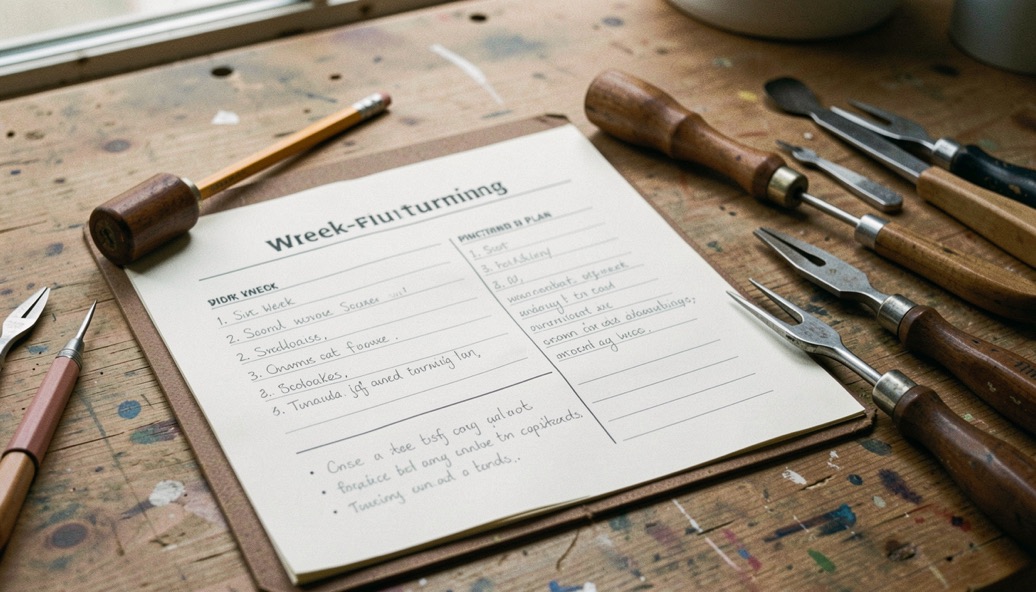
Weeks one and two
Learn the machine, the tool rest and the language of the cut. Make cylinders and beads in forgiving stock. Practice stopping, measuring and resetting rather than chasing a dramatic shape.
Weeks three and four
Add a simple bowl or cove, keeping the form small enough to observe. Compare a fresh note from the species desk with what the blank actually does.
Weeks five and six
Repeat one form, improve the surface and write a care note for the finished object. If the shop feels uncertain, return to the safety checklist before adding speed or complexity.
Weeks one and two: machine literacy
Begin with the machine stopped and learn how the banjo, rest, tailstock, drive center and speed control move. Practice mounting sound beech or basswood, rotating the blank by hand and finding a comfortable stance. Make cylinders, stop to measure and learn where the line of fire is. The objective is not a finished profile. It is to create a repeatable start and stop procedure that remains safe when the blank is less cooperative. Keep a notebook with tool, wood and one observation.
Weeks three and four: controlled forms
Add beads, coves or a small bowl only after the cylinder is predictable. Use a parting tool to establish reference points, a supported gouge for the transition and calipers to check symmetry. Compare a forgiving species with a more open-grained blank so the learner sees why tool sharpness and grain direction matter. Stop after a catch, tearout or vibration and diagnose it with the machine off. A teacher, club or manufacturer’s manual can correct stance and setup faster than repeated guessing.
Weeks five and six: finish and judgment
Repeat one form rather than adding complexity every session. Improve the cut surface, learn a dust-safe sanding routine and apply a finish only after reading its cure and care instructions. Write what the object is for and what it cannot tolerate. A useful final project might be a small dry-use bowl in cherry, but a cracked blank should become practice stock instead. Progress means safer choices, clearer vocabulary and better limits, not a dramatic object made before the hands are ready.
Adapt the sequence to evidence
Six weeks is a scaffold, not a deadline. If the learner cannot stop, measure or sharpen without rushing, repeat the earlier block. If the blank, tool or room creates uncertainty, simplify the project before adding a new technique. A mentor can adjust the order for a spindle specialist, a bowl learner or someone returning after an injury. Keep the safety checklist visible and assess fatigue honestly. The final measure is whether the learner can explain what the wood is doing, what the tool is doing and when the correct response is to stop. That judgment matters more than a calendar.
Precise safety and material claims are grounded in the editorial methodology; workshop guidance is identified as practical synthesis.